The Music Felt Loud – by Molly Booker
The music felt loud.
Not louder. Just loud. I was driving our RV from Sandusky, Ohio to South Haven, Michigan when I noticed it. Two hours earlier, the exact same playlist had sounded fine. Now every song felt one click too high. I shifted in my seat and tried to get comfortable. My lower back felt tight. My legs felt restless. Something inside me felt like a spring slowly winding itself tighter.
Twenty years ago, I would have ignored every one of those signals. In fact, I would have been proud of it. I would have stared at the GPS like a stalker, calculating arrival times and convincing myself that stopping was weakness. If there were three hours left, I drove three hours. If there were six hours left, I drove six. The body had opinions, of course. Hunger, exhaustion, stiffness, boredom. I just wasn’t particularly interested in hearing them.
That’s the funny thing about growing up. We spend years learning how to override ourselves and then decades trying to undo the lesson. When I was a kid, my brothers and I got our first pair of rollerblades while visiting my grandmother in New Mexico. Her neighborhood felt exotic compared to where we lived in the mountains of Colorado. There were sidewalks, curbs, and long stretches of pavement that seemed designed specifically for adventure.
My brothers immediately started jumping curbs. They would crouch low, gain speed, hit the lip of a driveway, and launch themselves into the air. It looked incredible. They nudged me into trying it in the way only siblings can—equal parts encouragement and peer pressure. Eventually I gave in. I bent my knees, picked up speed, felt the rush of the dip and then the rise, and jumped.
For one glorious second, I was flying. Then I remembered I would eventually have to land.
Which I did.
Directly on both kneecaps.
The skin disappeared instantly. Blood appeared just as fast. My brothers rushed over, not to look at my knees, but to look at my face. The question wasn’t whether I was hurt. The question was whether I was going to cry.
I felt the tears rise and saw them watching. Nope, I thought. Push those down. Way down. I stood up and kept skating. My brothers grinned.
“Gnarly.”
I had passed the test.
Looking back, I think that moment taught me something that took forty years to unlearn. Ignore the signal. Keep going. The body says one thing, do another. Pain becomes information you override instead of information you listen to. That strategy worked surprisingly well for a long time. Until it didn’t.
Which may be why I am so fascinated by Shelly.
Shelly is our RV, and one of my favorite things about her is that when we arrive at a campsite, she levels herself. You push a button and the jacks lower automatically. The camper shifts, pauses, adjusts, then shifts again. Somewhere underneath, sensors are making tiny calculations. A little higher here. A little lower there. Less than a minute later, everything settles into place.
I never get tired of watching it.
Partly because it’s cool. Partly because I still have the attention span of a ten-year-old when heavy machinery is involved. Mostly because it feels like magic. This weekend, while we were packing up outside Cedar Point, I noticed a woman standing near the campsite next to ours staring at Shelly while the leveling jacks did their thing. Not admiring her exactly. Studying her. The way someone might watch another traveler board the last lifeboat.
A few minutes later she disappeared back to her own camper where she and her husband began what appeared to be the manual version of leveling. There were blocks involved. There was backing up and pulling forward. There was crouching to check a bubble level and then waving someone ahead six inches. There was more backing up. More pulling forward. More checking. More discussion. At one point she stood with both hands on her hips staring into the distance while her husband repositioned the camper yet again. The whole thing looked exhausting.
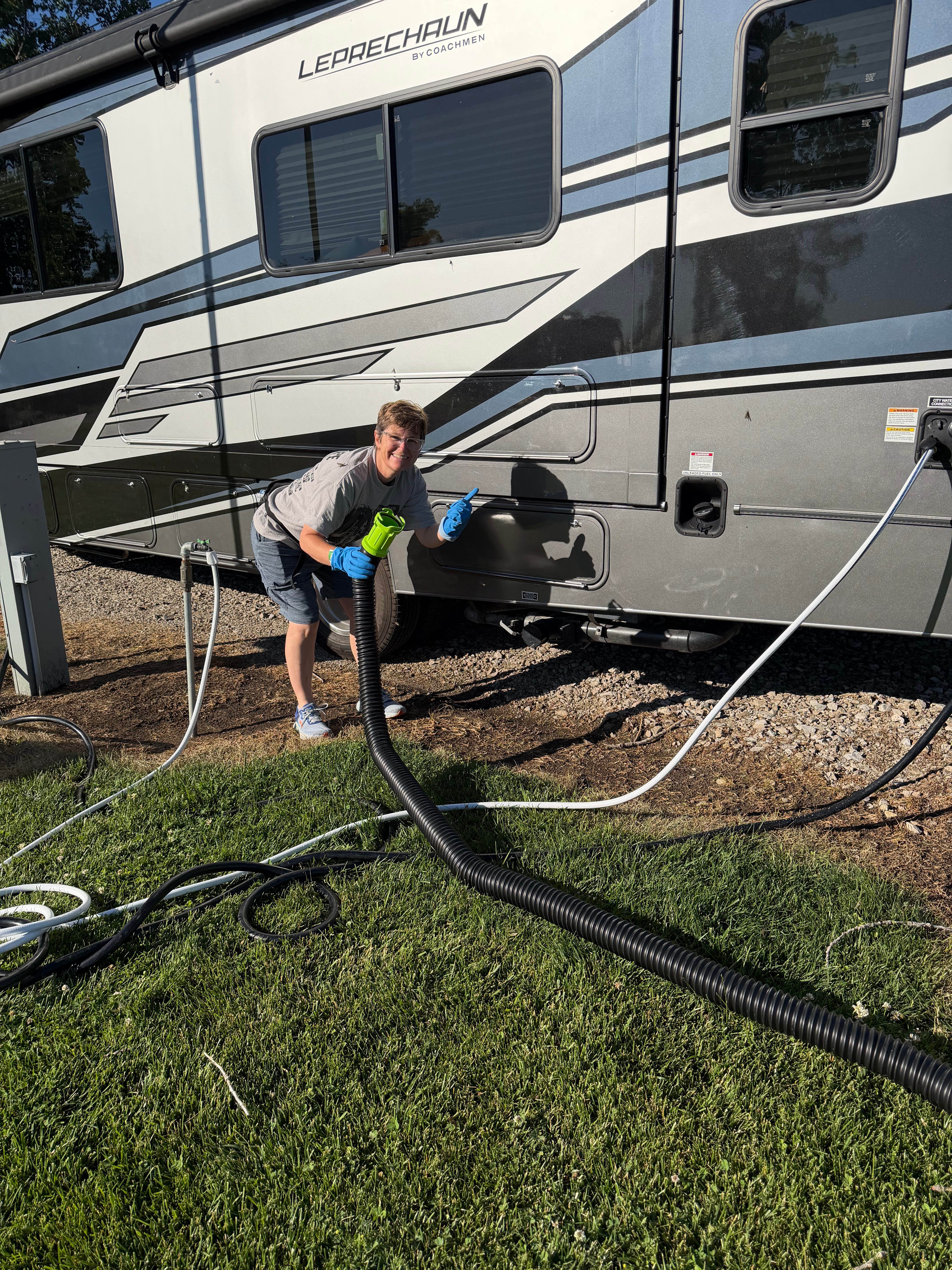
Meanwhile, Shelly had already finished.
Watching them, I realized something. When Shelly notices she’s off level, she doesn’t debate it. She doesn’t shame herself. She doesn’t tell herself she’s fine. She doesn’t decide she can make it through one more night leaning slightly to the left. She adjusts. Then she gets on with her day.
For most of my life, I wasn’t very good at that.
Or maybe I was too good at the opposite.
I learned how to ignore hunger. Ignore exhaustion. Ignore sadness. Ignore discomfort. Ignore the little signals that something needed attention. The problem with ignoring those signals is that they don’t disappear. They accumulate. A little tension here. A little frustration there. A little fatigue. A little disappointment. A little resentment. Until suddenly you’re simmering.
That’s the word that comes to mind.
Simmering.
The light turns red and you’re irrationally irritated. You spill coffee on yourself and somehow it’s a personal attack. Someone says the wrong thing. Someone moves too slowly. During my first marriage, there were seasons when I was so far off balance that another person’s breathing could annoy me. Not because they were doing anything wrong. Because I was compensating for so much that I didn’t have room for anything else.
The camper knows this. Apparently, I’m finally learning it too.
Somewhere on that drive through Michigan, I noticed the music felt loud. Then I noticed I couldn’t get comfortable in my seat. Then I noticed the restlessness. The tightness. The spring winding itself tighter and tighter. None of those things were problems. They were information.
So we pulled over.
The moment I stepped out of the driver’s seat, I felt relief move through my body. My legs loosened. My back stretched. The pressure released. The sun hit my skin. I stood there for a moment doing absolutely nothing except appreciating the fact that I was no longer sitting. Kelly took longer than I did to get out of the RV. I waited. We walked inside, used the restroom, and debated our lunch options.
Pizza?
Maybe.
Burger?
No.
Popeyes.
My older brother loved Popeyes, so chicken and mashed potatoes it was.
We carried our trays to a little table by the window and sat down in a patch of sunlight. Like two cats finding the warmest spot in the house, we settled in. The biscuits came with honey. Good Lord. Those biscuits. I don’t know why biscuits aren’t receiving more national attention. We sat there eating chicken, mashed potatoes, and biscuits while the sun warmed our faces.
At some point I realized I hadn’t thought about the GPS in half an hour.
I wasn’t calculating arrival times. I wasn’t trying to optimize the route. I wasn’t trying to get ahead. I was just eating lunch with my wife.
For most of my life, I thought resilience meant pushing through discomfort. Ignore the signal. Keep going. Don’t stop. Lately, I’m wondering if resilience might be something else entirely. Maybe resilience is noticing.
The sailor doesn’t wait until he’s miles off course to adjust. The camper doesn’t wait until things start rolling off the counter. The correction begins the moment the system notices something has shifted. What I’ve been building all these years isn’t balance so much as awareness. The ability to detect. To notice the dry eyes, the shallow breath, the tight hips, the restless hands, the music that suddenly feels loud.
Maybe that’s what a good life is.
Not a perfectly level one.
Just a willingness to notice when you’re leaning.
And maybe, if you’re lucky, to stop for a biscuit.